




The Royal Yacht
HM Yacht Britannia became a much-loved part of Cowes Week from 1955 to 1996 in support of Prince Philip’s participation in the regatta. A year after her final appearance in Cowes Week, Britannia was withdrawn from service following an emotional paying off ceremony held across the Solent in Portsmouth Dockyard on 11th December 1997. Her retirement signalled the end of an unbroken succession of Royal Yachts dating back to the reign of King Charles II. As the latest in this long line, the commissioning of Britannia in 1954 marked a significant step change from her predecessors. For the first time, a British Sovereign had a Royal Yacht that was genuinely capable of sailing around the world. This capability was used to good effect for nearly 44 years with Britannia steaming 1,087,623 nautical miles in support of the Royal Family’s work in locations as diverse as the Antarctic, the Caribbean, the Pacific, Africa, Russia and the Americas. In home waters, Britannia became the focus of major State and Naval occasions including Fleet Reviews and The Queen’s Silver Jubilee celebrations. In addition to these official duties, Britannia’s annual programme usually incorporated a visit to Cowes Week and a Western Isles cruise.
Although Britannia played an important role in the reign of Queen Elizabeth II, the project that resulted in her construction was initiated in 1936. However, the combination of King Edward VIII’s abdication, followed by the outbreak of WWII and the austerity of the early post war years, delayed the placing of an order for her construction until 4 February 1952. Sadly, this event was quickly overshadowed by King George VI’s death,h thereby leading to the personal involvement of Queen Elizabeth II and Prince Philip in the creation of what was to become one of their homes. This represented a unique opportunity for the Royal couple because their other residences had all been built by previous Monarchs. The Admiralty appointed Patrick McBride to design the Royal Apartments. He had designed the interiors of the Cunard liners Queen Mary and Queen Elizabeth. His initial drawings followed their grand style and did not meet with the Royal couple’s approval, so Prince Philip invited Sir Hugh Casson to inject some fresh ideas. This led to a more modest interior with the feel of a country house rather than a grand palace at s, ea which gave visitors the impression that they were coming to the Royal couple’s home rather than an official residence.
Britannia’s secondary role as a casualty evacuation ship was put to the test in January 1986 during her voyage to New Zealand and Australia for The Queen’s visits. Following her diversion to Aden, the Yacht evacuated 1,068 men, women and children of 55 different nationalities before resuming her journey to New Zealand, where she arrived just one day late! In later years, Britannia was used with increasing success, in-between her Royal duties, to promote British industry abroad through the hosting of sea days.
Britannia’s construction had been announced before the 1951 General Election without any controversy because the Prime Minister, Clement Atlee, had already consulted the opposition and secured their support for the plan. It proved to be an extremely wise precaution because he avoided dragging the Monarchy into party politics during the election campaign and her construction proceeded without delay under the newly elected Government following his party’s defeat. Sadly, John Major failed to learn this important lesson and made a critical error of judgement by failing to consult the opposition about its plans to replace Britannia. Seizing the opportunity to attack their opponents, the Labour Party turned it into a contentious political issue prior to the 1997 General Election without understanding Britannia’s contribution to the nation. Once in office, the Labour Party toyed with the idea of building another Royal Yacht or refitting Britannia until October 1997, when they announced she would be decommissioned without replacement.
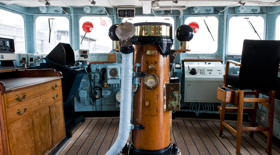
However, Britannia’s ultimate fate remained unresolved until April 1998 when the Government announced that the Forth Ports bid to bring her to Leith had won its competition to create a viable, dignified role for the Royal Yacht. Within a month, Britannia had arrived in the Scottish port to be converted for her second lease of life. The Royal Yacht Britannia Trust was formed to take on responsibility for her long term preservation. The manner in which she would be presented to the public required considerable sensitivity; it was clear that people would be most curious about the Royal Apartments. The issue broke new ground because the sleeping quarters of a reigning British Monarch had never been exhibited. Everyone agreed that the thought of people walking through the bedrooms would be inappropriate, and allowing people to peek through the door would cause congestion. It was therefore decided to remove whole sections of the wall and insert glass panels in keeping with the rhythm of the surrounding panels. Elsewhere, a new access was cut into the side of the hull to enable the engine room to be seen through a glass panel, thereby maximising its accessibility as part of the Trust’s determination to make her fully accessible to the disabled from the outset. The position of the wheelhouse, immediately below the bridge, was difficult to access, but its smaller size meant that it could be removed and re-assembled within the visitor centre.
In a remarkable race against the clock, the lifeless, empty Royal Yacht was transformed into a fully operational tourist attraction and hospitality venue within six months of arriving in Leith. Britannia opened to the public on 19 October 1998 at her temporary berth alongside a new purpose-built visitor centre, while her permanent home took shape across the basin. The Trust took the decision when she opened to only allow admission via pre-booked tickets to avoid overcrowding and visitors having to spend hours waiting in a queue. The plan worked, and she proved to be an instant hit by attracting 33,000 visitors during the first month. Within 12 months,s Britannia had firmly established herself in both markets. The events team had organised events for several major companies, es including Jaguar, Lloyds TSB and HMV UK Ltd. Meanwhile, 436,619 people had travelled to Leith to explore the Yacht, thereby making her the fourth most visited attraction in Scotland. Britannia also won its first award during this period when Group Leisure magazine bestowed its prestigious Best New Attraction 1998/1999 award upon her. A report prepared by the economic development consultants Segal Quince Wicksteed Ltd revealed that during the first 12 months Britannia generated over £12 million of new spending in the Edinburgh and Lothian economy, with an average of £24 being spent in the area by each visitor.
The Scottish Tourist Board awarded its prestigious five-star rating to Britannia in February 2001. At the time, this made her only the third tourist attraction in Edinburgh to have reached its highest standard. The scale of this achievement is even more impressive because it was the first time that Britannia had been formally assessed by the Scottish Tourist Board. Its grading system judged an attraction by its overall quality rather than simply reviewing its facilities. Thus, the Tourist Board’s inspectors assessed a much wider range of factors, including the interaction, appearance and behaviour of the staff and the experience provided throughout a visit to the attraction.
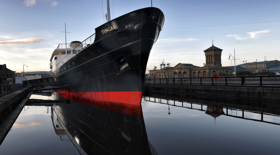
The Royal Yacht Britannia Trust was able to finally fulfil the original vision behind the Forth Ports bid to bring Britannia to Leith in September 2001, when she was towed across the basin to her permanent moorings beside the recently completed £120 million Ocean Terminal. Britannia had been a core part of Forth Ports’s plans for this high-profile regeneration project from the outset and helped attract the department store Debenhams as its anchor tenant. The move enabled The Royal Yacht Britannia Trust to open up more areas of the Yach,t as well as building a new visitor centre and shop incorporating the experience gained since 1998. Early research showed that visitors wanted to see more of Britannia, especially where the Yotties had lived. Thus, the forward part of the main deck was opened to enable people to visit the PetOfficers'ers and Chief Petty Officer’s messes, the Marine Barracks, the Junior Rates mess area, the Sick Bay, the Laundry, the Post Office and the NAAFI. The principal challenge presented by opening these areas was to maintain a logical one-way route that did not require significant alterations to the structure of the ship. However, the making of a further two access points could not be avoided, and, like the one made for the engine room, they were made to blend in with the style of the double doors in the aft part of the hull,l which were an original feature. Internally, an opening had to be cut through one bulkhead, ad and one item of machinery had to be moved to gain access to the junior Yachtsmen’s mess. Despite the limited nature of this work, it clearly highlights the difficult balancing act faced by preservation groups between maintaining an exhibit’s authenticity and providing access to people of all levels of mobility.
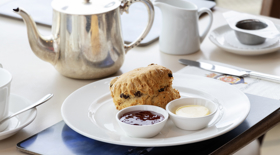
Having firmly established Britannia in her new roles at her permanent berth, the Trust began to embark on a series of exciting projects that were only made possible by the success of the Yacht’s preservation. The first of these occurred by chance when the Trust’s Chief Executive, Bob Downie, went up to inspect the repainting of the funnel in 2005 from the Royal Deck and was taken aback by the view of the port’s ongoing regeneration. When required, an awning would be rigged over this deck during Britannia’s time in service. This inspired the idea of creating a new purpose-built glazed structure as an additional function space that could also serve as a high-quality tea room to enhance the experience of visiting Britannia during the day. The Royal Deck Tea Room opened on 19 March 2010, and its profits repaid the building costs, which had been covered by the Trust’s savings, within 5 years.
This period also witnessed the building of a very successful, mutually beneficial relationship between the Trust and the Yotties. The most visible sign of this unique relationship is the annual Yotties Week when a contingent of Yotties return to their former home to assist the Trust’s maintenance team and provide the visitors with a unique insight into Britannia’s rich heritage. In addition to sharing stories of their time in Britannia with the visitors, the Yotties gather up on the Verandah Deck every afternoon to reenact the traditional Rum Tot ceremony.
The Trust’s remit expanded in 2010 when it purchased the Royal Racing Yacht Bloodhound, which was put on display beside Britannia for most of the year before heading to the West Coast for a series of skippered charters during July and August. Manned by a crew of Yotties, they recreated the experience of sailing Bloodhound among the Western Isles that had been enjoyed by the Royal Family while she was owned by Queen Elizabeth II and Prince Philip in the 1960s.
A year later, the Trust had the great honour to host the pre-wedding drinks reception for The Princess Royal’s daughter, Zara Phillips, and the England rugby player Mike Tindall on 29 July 2011. Their guests included several senior members of the Royal Family who returned to Britannia for the first time since her paying off ceremony in 1997. It proved to be a glorious summer’s evening and a very special way for the Trust to enable the Royal Family to maintain its links to Britannia.
That autumn, the Trust embarked on its most ambitious joint project so far with the Yotties to recommission The Royal Barge and Britannia’s two Fast Motor Launches (FMLs). They were to play a very special role at the beginning ofthe River Pageant that was held on the River Thames on 3 June 2012 to celebrate Queen Elizabeth II’s Diamond Jubilee. Neither Britannia nor the Royal Barge are permitted to leave the Port of Leith without the Ministry of Defence’s agreement under the terms of the Trust’s original legal agreement to purchase Britannia. However, once it reviewed the Trust’s plans for the Royal Barge’s involvement in the River Pageant, the Ministry of Defence happily granted permission for her to head south. Five Yotties spent several weekends in Leith overhauling the trio of boats before they were taken by road to London. For the first time since 1997, the Royal Barge was afforded the extremely rare privilege of wearing The Royal Standard when Queen Elizabeth II, accompanied by Prince Philip, The Prince of WaWales d The Duchess of Cornwall, joined in Chelsea. Escorted by the two FMLs, the Royal Barge conveyed the Royal Party about ¾ mile downstream to Cadogan Pier, where they transferred to MV Spirit of Chartwell,l which had been temporarily converted into the primary ceremonial barge for the event. The Royal party clearly enjoyed their brief reunion with the trio of craft and the Yotties who manned them at the start of an incredible event to mark yet another historic milestone in Her Majesty’s reign.
After six years of negotiations, the Trust finally reached a deal to acquire the former Northern Lighthouse Tender MV Fingal in 2014. She was subsequently transformed into Leith’s first floating boutique hotel with 23 cabins, including 4 duplex cabins; The Lighthouse Restaurant & Bar; The Bridge, an intimate private dining room;m, and a versatile ballroom capable of seating up to 70 people for dinner. The Trust’s primary objective for taking on such an ambitious project was to establish another source of income that could help secure Britannia’s long-term future if her visitor numbers ever dropped below the level required to cover her running costs. Fingal benefited from the experience gained by Britannia’s team since 1998, which provided the new venture with a tremendous head start, as well as increasing the breadth of options Britannia’s events team could offer its clients.
Officially opened by The Princess Royal in July 2018, Fingal welcomed her first guests onboard in January 2019. Six months later, a private dinner was organised for Queen Elizabeth II in Fingal’s Lighthouse Restaurant & Bar, much to the astonishment and delight of the staff and other diners. So far, the five-star (AA) luxury floating hotel’s accolades include winning Tripadvisor’s Number 1 in the UK and Number 4 in the World ‘One Of A Kind’ Hotels category in 2025; Tripadvisor's No.1 UK Luxury Hotel category in 2024; Tripadvisor's No.1 UK Small & Boutique Hotel 2024 and the 2023 AA Hotel of the Year Scotland. The Lighthouse Restaurant & Bar has been awarded two AA Rosettes for culinary excellence, while Fingal has also achieved the Keep Scotland Beautiful Gold Level National Award for Environmental Excellence and Green Key.
Fingal’s acquisition led to the further expansion of the Trust’s fleet when Bob Downie travelled to Falmouth to finally take possession of her in July 2014. In view of her strong links to Britannia, Bob wanted to take advantage of this visit to finally see the Royal Racing Yacht Bluebottle at the National Maritime Museum Cornwall (NMMC). He was shocked to discover that Bluebottle was no longer on display and had been laid up in a nearby car park while the NMMC’s volunteers tried to raise the funds for her restoration. With the approval of Prince Philip, the Trust took on responsibility for Bluebottle’s restoration and return to top-flight racing in 2017. After an extensive restoration by David Heritage Racing Yachts in Cowes, Bluebottle returned to the international regatta circuit in style by winning the Dragon Series with a day to spare during the 2021 Cowes Week. Since then, she has gone on to compete in national and international events in Scotland, Wales, Germany, Belgium, Turkey, France, Ireland, Portugal and Estonia.
In 2017, the Trust also took on responsibility for the preservation of the Royal Racing Yacht Coweslip, which subsequently enabled the Trust to bring Bluebottle, Bloodhound, Coweslip and Britannia together in the same location for the very first time. Coweslip is usually displayed in Leith alongside Britannia between occasional return visits to Cowes for special events, including the 50th anniversary of Uffa Fox’s death and the 200th anniversary of Cowes Week.
The Port of London Authority’s (PLA) ceremonial Barge Royal Nore became the third historic craft to join the Trust’s fleet in 2017. Acquired for the princely sum of £1, Royal Nore is currently on display astern of Britannia.
The 25th anniversary of Britannia’s arrival in Leith was celebrated in style when King Charles III returned to the Yacht on 3 July 2023 for a private tour and to meet some of the Yotties who participate in the annual working party. His Majesty was invited to participate in the traditional Rum Tot ceremony and appeared to thoroughly enjoy his return to the Yacht.
Like Fingal, Britannia’s success has been recognised by a series of high-profile awards since 1998, including Tripadvisor’s Number 1 UK attraction in 2014, 2023, 2024 and 2025. These awards recognised the consistently high-quality experience provided by the hard-working Britannia team and were topped by Tripadvisor’s announcement on 28 April 2026 that Britannia had been named the “Best of Best” Number 1 attraction in the UK, Europe and the World – the first British tourist attraction to win the world title, which is an incredible achievement in view of the legendary competition. To have been named the world’s best visitor attraction would have been beyond the wildest dreams of the intrepid team who transformed the empty, lifeless Royal Yacht into a world-class tourist attraction and events venue in 1998. Yet, their hard work, imagination, and ethos laid the foundations for an organisation that has gone on to make a significant contribution to Leith’s regeneration; preserved three former Royal Racing Yachts and a ceremonial barge; opened an award wining 5 star hotel, restaurant and events venue, while providing a sustainable, dignified future for Britannia in accordance with the stated objectives of two successive British Governments.